Showing posts with label preserves. Show all posts

Friday, October 11, 2013

Fire Roasted Red Peppers Preserved

Roasting the peppers
Every fall, baskets of peppers appear at all of the Italian markets in town.  I first began roasting peppers with my friend Cathy on the roof of a building on Queen Street in the eighties.  Cathy had been introduced to roasting peppers by a friend from one of those Mediterranean countries that have such great food traditions, and suggested we try preserving roasted peppers.  The first year we made our best guess, and by the second year we had the process down, and began including our friend Sean in what became an fall ritual for a number of years.

I had an old Weber barbecue that we would load up with charcoal and then spend the evening roasting peppers and drinking wine.  At the end of a long night we would have a counter full of bottles of red peppers that we would split up and use for the winter.

Fire Roasted Peppers in Olive Oil
I now make the peppers in the country over coals from an open fire.

1 case of red peppers
1 litre of olive oil
6 organic lemons
24 - 250 mm preserving bottles
lots of old newspaper

Build a fire a couple of hours before you are ready to start.  Build a deep bed of coals.  Keep at least one log on the edge of the fire so that there is a constant source of new coals to complete the job.

Place grill close to the coals. Arrange peppers on the grill, making sure that there is room around each pepper.  Allow the skins to become black and then rotate the peppers, so that all sides of the pepper are black.

Remove peppers from the grill, and wrap groups of 4 to 6 pepper in newspaper to allow to sweat.

Meanwhile, sterilize bottles.

Wash lemons and cut into sections.  Place one section in each of the sterilized bottles.

Peel the blackened skin off the peppers and remove the core and seeds.  Discard skins and seeds.  Tear peppers into strips and pack into the sterilized bottles to about a half inch from the top.

Fill bottles with olive oil to about a !/4 inch from the top.  Tap bottles on counter, and run sterilized knife around perimeter of bottles to dislodge any air bubbles.  Seal jars and process for 15 minutes.

Because the peppers are preserved in olive oil, the oil is fabulous to use as well.


Sunday, December 9, 2012

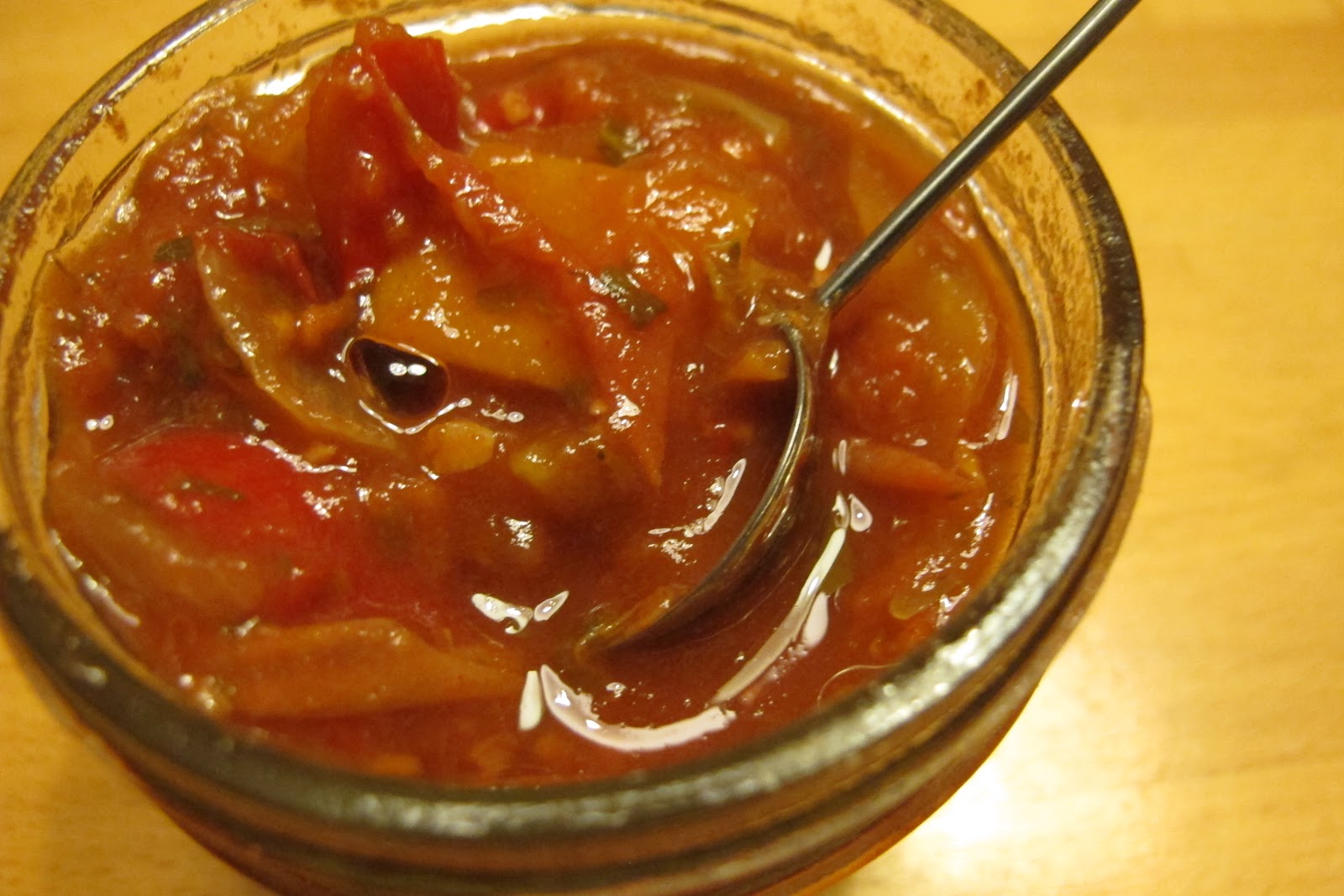
Red-Hot Salsa

Red -Hot Salsa

This fall, I had a bounty of tomatoes and peppers as the first frost approached. I made three different types of salsas with the tomatoes and peppers, and I have finally tasted the Red-Hot Salsa this weekend. After a couple of months of mellowing, this year's, Red-Hot is particularly good I think, because it was a very hot and sunny summer, resulting in fabulous tomatoes and peppers.  I used a combination of the brandywine, beefsteak and plum tomatoes, with the scotch bonnet, chili, and jalapeño hot peppers, that I grew in my garden this summer.   


Brandywine Tomato on the Vine

  • 6 cups of chopped red tomatoes
  • 4 cups of a selection of red, orange and yellow sweet peppers, chopped
  • 2 cups of chopped onions
  • 4 cloves of minced garlic
  • 2 cups of cider vinegar
  • 1/2 cup of finely chopped hot peppers with the seeds removed (be sure to wear rubber gloves and keep hands away from face)
  • 1/4 cup of sugar
  • 1 tablespoon of salt
  • 2 tablespoons of  Spanish hot smokey paprika
  • 3 tablespoon of chopped  fresh oregano
  • 1/4 cup of chopped fresh flat leafed parsley


Put all of the ingredients, except the parsley, into a large heavy enamelled or stainless steel pot.  Bring to a boil, stirring often.  Reduce  the heat and simmer for about an hour, stirring often.  When the salsa is thick enough, a tablespoon of the salsa dropped on a cold plate will flow slowly when tilted. Stir in the parsley and simmer for 5 minutes, stirring occasionally. 

Place the salsa in preserving bottles, remove air bubbles, screw lids on tightly and process  1 cup jars for 15 minutes, and 20 minutes for 2 cup jars.  This makes about 8 cups of salsa.  

If you can wait, the salsa tastes better after it has had a chance to mellow for a month or two. 

Tuesday, July 10, 2012

Three Types of Strawberry Jam

The sky opened up and it rained hard on Saturday morning, and all of the local gardeners and farmers were ecstatic.  It had been scorchingly hot, with no rain for a few weeks. My neighbour, Peter, referred to the storm as 'the million dollar rain'.  The local Saturday morning market was a bit sparse and so when I saw the flats of strawberries, I thought strawberry jam, either that, or tackle organizing the basement.  It was an easy decision.  Strawberry Jam.

When I got home I pulled out my Small Batch Preserving, by Margaret Howard,  and found a couple of recipes, one with sherry, and another with balsamic vinegar.  My mother had a fondness for Harvey's Bristol Cream Sherry, and I had the remnants of a bottle from years ago in the cupboard.  The other recipe reminded me of one of my favourite deserts, strawberries with balsamic vinegar and crushed black peppercorns. 


After making these recipes there were still strawberries left over, and I thought a classic jam, and so I made what started out to be Plane Jane Strawberry Jam until, Andrea, who was visiting, suggested I add tarragon "just to add a bit of interest", so the third batch is French Tarragon Strawberry Jam.  
Three Types of Strawberry Jam


Balsamic and Peppercorn Strawberry Jam


  • 8 cups of small strawberries, cleaned and hulled
  • 4 cups of sugar
  • 1/4 cup of balsamic vinegar
  • 1/2 teaspoon of coarsely crushed peppercorns

Combine strawberries and sugar in large stainless steel pot.  Let it stand for at least two hours, stirring occasionally.  Add vinegar and bring to a hard boil and continue boiling gently for 10 minutes.  Remove from heat and add peppercorns.

Pour into large flat glass or enamel pans to 1/2 inch depth.  Place in oven and bake at 170F for 10 hours, or in a convection oven for 3 hours.  Stir occasionally.


Ladle into 8 oz sterilized bottles and screw on lids.  Process for 10 minutes.  Makes 5 bottles. 


Mom's Harvey's Bristol Cream with Strawberry Preserves

  • 5 cups of cleaned and hulled small strawberries
  • 4 cups of sugar
  • juice of one lemon
  • I pouch of liquid fruit pectin
  • 1/2 cup of Harvey's Bristol Cream
Stir sugar, lemon and strawberries in stainless steel or enamel pot and let stand for 4 or 5 hours. Bring to boil over high heat, stirring constantly, and boil hard for 2 minutes. remove from heat, and add pectin and sherry.
Ladle into 8 ounce, wide mouthed, sterilized bottles and process for 10 minutes.  Makes 4, 8 ounce bottles.

Andrea's Tarragon Strawberry Jam


  • 5 cups of strawberries, half slightly crushed, the other half cut in half
  • 4 cups of sugar
  • juice from 2 lemons
  • 1 tablespoon of finely chopped fresh tarragon
  • 1 envelop of pectin
Mix berries, lemon juice and sugar and let stand for 8 hours.  Put in stainless steel pot and boil for 5 minutes.  Stir in pectin and cook for another minute.  Remove form heat and stir in tarragon.
Ladle into bottles and process for 10 minutes.  Makes 4, 8 ounce bottles

Monday, May 14, 2012

Pickled Wild Leeks or Ramps

My daughter came up north this weekend, and since there were still morels on the front lawn, and lots of wild leeks in the woods, suggested a repeat performance of last week's dinner, complete with cheese.  Because Claire has been off dairy lately, I hadn't anticipated this and was short of Parmesan cheese.  This tuned out to be one of those happy accidents because this week's risotto turned out to be better than last week's.  I am not sure about blog etiquette, however, I have gone back and adjusted the risotto recipe to reflect the reduced cheese.

When digging leeks for the risotto, I noticed the first of the buds were starting to form on the ramps.  This is the first sign of the end of the leek season. Time is running out to preserve ramps, so picked Ramps became the weekend project.

Pickled Wild Leeks (Ramps) will turn a pale pink as they age


I like to pickle the leek bulbs with no seasoning, to allow for more flexibility when using them later. I save the leek greens to use in salads or sauté and serve as a side.


Ingredients

  • 50 to 60 wild leeks
  • 1/2 cup of white vinegar
  • 1/3 cup of rice vinegar
  • 2 tablespoons of kosher salt
  • 2 tablespoons of sugar
  • 2 250 ml wide mouthed canning jars
Clean wild leeks and cut off greens just above the bulb. Save greens for another use.
Place leek bulbs in a sterilized jar.
Mix vinegars, salt and sugar together in a stainless steel pot and bring to the boil.
Fill jar to 1/2" from top and screw on lid.
Process jar in boiling water for 20 minutes. Tighten lid and store in a dark place until ready to use.  These are best after a couple of weeks.


If you are pickling more than a few bottles, experiment with different spices in some of the bottles.  A half teaspoon of picking spices with a small Tai chili pepper in each  bottle works well.  


And it goes without saying that it is very important to only harvest a very small portion of any wild leek patch, as they take years to develop.  I have read, I forget where, that a large leek bulb may be 20 years old.  I transplanted a patch of wild leeks from the country to the city under some large trees, and while they come up every year, the patch is only a tiny bit larger after 5 years.